Smart Factory Trends 2026: Where the ROI Actually Is for SMEs
Seven in ten Industry 4.0 pilots never scale. The seven trends that do — ranked by proven ROI for high-mix, low-volume manufacturers, not by vendor hype.
Apr 1, 2026 · 14 min read Verified 2026-04-07
70% of Industry 4.0 pilots never scale — yet the 30% that do follow a pattern: they start with the right problem, not the trendiest technology. For mid-sized manufacturers running high-mix, low-volume production with manual assembly and high-value mechatronic products, that pattern looks fundamentally different from the playbook written for automotive lines. This article identifies the seven trends that matter most — ranked by proven ROI for your production profile, not by vendor hype.
- Adoption gap: Mid-sized firms trail large enterprises by **25 percentage points ** in smart manufacturing adoption (Eurostat 2025)
- Top HMLV ROI: Digital work instructions cut assembly errors by **40-60% ** and instruction authoring time by **97% **
- Scheduling lever: AI-driven HMLV scheduling improves on-time delivery by **15-25% ** — the metric that moves revenue
- Traceability gap: Two-thirds of EU manufacturers are unprepared for Digital Product Passport requirements (2027-2030)
- Cost floor: Cloud MES starts at **€800-2,000/month **; CNC monitoring pilot costs **under €28K **
- Success ratio: Manufacturing AI delivers **200% average ROI ** — highest of any sector — but only when matched to the actual bottleneck
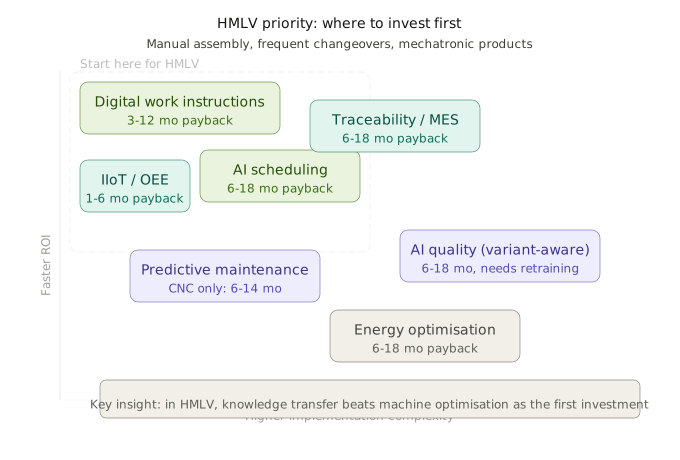
- Verdict: For high-mix manual assembly, start with work instructions and traceability — not predictive maintenance. Your bottleneck is knowledge transfer, not machine uptime.
Five Core Messages
Trend Comparison: Where to Put Your Money
| Trend | ROI | Complexity | Primary HMLV value | Start here |
|---|---|---|---|---|
| Digital work instructions | 3-12 mo | Low-Medium | 40-60% fewer errors | Highest-error station |
| AI scheduling | 6-18 mo | Medium | 15-25% better OTD (On-Time Delivery) | Replace the spreadsheet |
| Traceability / MES | 6-18 mo | Medium-High | Liability + DPP (Digital Product Passport) ready | Highest-value product |
| CNC monitoring (IIoT) | 1-6 mo | Low | Utilisation visibility | 3-5 expensive machines |
| Predictive maintenance | 6-14 mo | Low-Medium | 30-50% less CNC downtime | Spindles, compressors |
| AI quality inspection | 6-18 mo | Medium-High | Variant-aware defect detection | Final assembly verification |
| Energy optimisation | 6-18 mo | Low | 15-25% energy reduction | CNC idle-time elimination |
Trend 1: Digital Work Instructions
Core message: digitise the operator first, the machine second
What it is
Software that dynamically generates step-by-step visual assembly guidance from BOM (Bill of Materials) and CAD (Computer-Aided Design) data — delivering variant-specific instructions to a tablet, monitor, or AR (Augmented Reality) glasses at the workstation. The system automatically adjusts for the exact product configuration on the current work order and the skill level of the assigned operator. When integrated with an MES (Manufacturing Execution System), every completed step becomes a traceability record.
The problem
When an operator assembles 10-15 mechatronic variants per week — each with different cable routing, PCB (Printed Circuit Board) placement, firmware versions — paper instructions are the primary error source. This is the HMLV (High-Mix, Low-Volume) equivalent of unplanned downtime in high-volume plants.
Measured results from real deployments
- 40-60% reduction in assembly errors through variant-specific visual guidance generated from BOM and CAD data
- 97% reduction in instruction authoring — one aerospace manufacturer cut creation time from 4 days to 1 hour using AI-assisted platforms
- 75% faster operator training — new hires reach productive speed in days, not weeks (Forrester TEI study for AR implementations)
- Zero-error wiring harness assembly achieved at Boeing using AR-guided instructions
What it costs
SaaS platforms (Tulip, Poka, Workerbase) run €500-2,000/month . For 20 assembly operators, that’s €12K-24K/year — paying back in 3-6 months through error reduction alone. AR glasses (RealWear Navigator 520, ~€2,300/unit) add hands-free capability but aren’t needed to start.
How to start
Pick your highest-error assembly station. Deploy tablet-based instructions for that single station. Measure error rate for 3 months before scaling. Don’t start with AR glasses — start with screens.
Trend 2: AI Scheduling for High-Mix Production
Core message: a 15% OTD improvement is worth more than a 5% OEE gain
What it is
Machine learning algorithms that continuously optimise production plans across all constraints simultaneously — machine availability, operator skills, material status, sequence-dependent setup times, and customer due dates. Unlike traditional APS (Advanced Planning and Scheduling) systems that produce a static plan, AI schedulers re-optimise in real time as rush orders arrive, machines go down, or materials are delayed. For HMLV, this is the difference between a plan that’s obsolete by Tuesday and one that adapts by the hour.
The problem
HMLV scheduling is NP-hard: hundreds of orders, sequence-dependent setups, material constraints, bottlenecks that migrate daily. Spreadsheet scheduling is the #1 operational constraint most mid-sized manufacturers won’t name.
Measured results from real deployments
- 15-25% improvement in OTD (On-Time Delivery) — the metric HMLV customers actually care about
- 10-30% reduction in setup time through intelligent job sequencing (grouping similar material/tooling runs)
- Siemens Drives Congleton (UK, high-mix motor drives): delivery capability jumped from 58% to over 90% with Opcenter APS
- Over 40% of manufacturers with scheduling systems will upgrade to AI capabilities by 2026 (IDC FutureScape)
What it costs
Mid-market tools purpose-built for HMLV job shops: Delfoi Planner, PlanetTogether at €18K-92K . SaaS options like “just plan it” start at €5K-50K/year. Enterprise platforms (Siemens Opcenter APS) run €200K+. For a manufacturer losing 5-15% of revenue to late deliveries, even modest scheduling improvement delivers 6-figure annual savings.
How to start
If you’re on spreadsheets, any mid-market APS tool is a massive improvement. Run it in parallel with your current planner for 4-6 weeks. Let the planner validate before going live — their domain knowledge of customer priorities and material constraints remains essential.
| What vendors claim (Noise) | What evidence shows (Signal) |
|---|---|
| AI replaces production planners | AI handles routine rescheduling; planners focus on exceptions and strategy |
| One algorithm fits all factories | HMLV needs sequence-dependent setup optimisation — generic schedulers miss this |
| ROI in weeks | Realistic: 6-18 months including data cleanup and planner trust-building |
Trend 3: Traceability and MES
Core message: traceability is the difference between a €15K incident and a €500K recall
What it is
A Manufacturing Execution System (MES) sits between the shop floor and the ERP (Enterprise Resource Planning) system, tracking every product unit through production in real time. For HMLV mechatronic manufacturers, the critical function is serial-number-level traceability: recording exactly which components (down to PCB lot and firmware revision), which process parameters, which test results, and which operator built each individual unit.
The problem
High-value mechatronic products with embedded firmware need serial-number-level traceability: which firmware version, which PCB revision, which components, which test results, which operator. Without it, a single field failure becomes a full product-line recall instead of a 47-unit targeted response.
Measured results from real deployments
- Serial-level traceability cuts recall scope by 80-90% — from 10,000 units to the specific lot affected
- Cloud MES delivers 10-20% less downtime, 15-30% scrap reduction in typical deployments
- Tulip achieved 448% ROI over 3 years (Forrester Total Economic Impact study)
- Builds the data foundation for EU DPP (Digital Product Passport) compliance — batteries by Feb 2027, metals mid-2027
- One MES vendor reports customers seeing ROI from the process cleanup alone before the software was fully installed
What it costs
Cloud MES starts at €800-2,000/month (Tulip, Symestic, Sepasoft). On-premise enterprise MES runs €100K-500K+. For HMLV, the ROI case isn’t marginal OEE improvement — it’s avoiding a single catastrophic field recall (€500K-5M for mechatronic products) and building DPP-ready infrastructure before the deadline.
How to start
Deploy cloud MES on one product line — your highest-value product. Start with two modules only: traceability (serial-level component tracking) and digital work instructions. Add quality and OEE modules in Phase 2.
- If you supply automotive or industrial OEMs (Original Equipment Manufacturers), Catena-X / Manufacturing-X readiness is becoming a procurement requirement — not a technology option
- Two-thirds of EU manufacturers have not started DPP preparation. The compliance window is 18-36 months, not 5 years
- Every digital work instruction automatically becomes a traceability record — Trends 1 and 3 reinforce each other
- Budget 30-50% of software cost for ERP integration — MES without ERP connection is an island
Trend 4: CNC Monitoring and Predictive Maintenance
Core message: a €28K monitoring pilot tells you more than a €200K AI platform
What it is
Two distinct technologies sharing the same sensor infrastructure on your CNC (Computer Numerical Control) machines. Machine monitoring (IIoT — Industrial Internet of Things) connects machines to dashboards displaying real-time OEE (Overall Equipment Effectiveness), cycle times, and downtimes. Predictive maintenance goes further: ML (Machine Learning) models analyse vibration, temperature, and current data to predict failures days to months before they happen, replacing calendar-based schedules with condition-based interventions.
The problem
Most HMLV shops track CNC utilisation by gut feel or operator self-reporting — which overstates actual productive time by 15-25% . Without real data on setup durations, idle gaps between jobs, and unplanned stops, scheduling improvements (Trend 2) have no baseline to optimise against. For predictive maintenance specifically, calendar-based service wastes money on healthy machines while missing the failing ones.
Measured results — machine monitoring
- BC Machining (USA, SME): payback within 1 month — actual utilisation was 20% lower than operators reported
- 3-machine pilot costs under €28K total. Protocol gateways (Softing, Moxa) connect legacy CNC controllers at €2K-10K each in 2-7 days
- For HMLV, the most valuable data: setup time by product family and machine idle time between jobs — these directly feed scheduling improvement (Trend 2)
Measured results — predictive maintenance
- 30-50% reduction in unplanned downtime; 95% of adopters report positive ROI
- 18-25% lower maintenance costs versus preventive approaches
- Pilot on 3-5 CNC assets costs €28K-46K ; payback within 12 months typical
- Focus on: CNC spindles, hydraulic presses, compressors, test chambers. Don’t deploy on manual assembly stations
What it costs
Machine monitoring: under €28K for a 3-machine pilot; €2K-10K per machine for protocol gateways on legacy controllers. Predictive maintenance: €28K-46K for a 3-5 machine pilot including sensors and software. Both share the same connectivity investment — deploy monitoring first, add predictive models once you have 3-6 months of clean data.
How to start
Connect your 3-5 most expensive CNC machines this quarter using protocol gateways. Build dashboards showing utilisation, setup time, and cycle time per product family. Run for 3 months. Then — and only then — evaluate whether predictive maintenance adds value on top.
| What vendors claim (Noise) | What evidence shows for HMLV (Signal) |
|---|---|
| Predictive maintenance is the #1 smart factory investment | For HMLV, work instructions and scheduling deliver faster ROI — the bottleneck is knowledge, not uptime |
| You need a data lake before starting | You need 3 months of clean data from 5 machines, not a data lake |
| AI models work immediately | Models need 3-6 months of clean data before predictions become reliable |
Trend 5: AI Quality Inspection (Variant-Aware)
Core message: your inspector catches 3 in 4 defects — the wrong PCB revision is probably the one they miss
What it is
Deep learning vision systems — typically industrial cameras paired with edge AI compute hardware — that inspect products at production speed. The system compares what the camera sees against a reference model to detect surface defects, dimensional deviations, or assembly errors. For HMLV, the critical difference from standard deployments: the inspection criteria must change dynamically with each product variant, loading the correct reference from the BOM per work order rather than using a single fixed model.
The problem
Manual inspection catches only 70-80% of defects consistently. For HMLV mechatronic products, the most costly errors aren’t surface scratches — they’re wrong components in the right position or right components in the wrong orientation. These errors pass visual inspection because the assembler doesn’t notice a PCB revision difference, but they cause field failures worth €10K-50K per unit.
Measured results from real deployments
- 95-99% defect detection accuracy at full line speed versus 70-80% for manual inspection
- 70% reduction in scrap and rework in deployed systems
- Intel saves €1.8M annually ($2M) with AI vision inspection
- Edge AI inspection point costs €5K-30K (camera + NVIDIA Jetson at €229 + software)
What it costs
A single inspection station runs €5K-30K. For HMLV, the economics depend on your scrap cost: if misassembly costs €50K-200K/year in rework and field returns, a single station pays back in 3-12 months. The ongoing cost is training data — each new variant may require hundreds of labelled images.
How to start
Deploy at your final assembly verification station — the last check before packing. Start with component presence/absence detection (is the right PCB in the right slot?), not surface defect detection. Use systems that can load inspection criteria from BOM data per order (Cognex ViDi, Landing AI, or custom solutions on NVIDIA Jetson).
Trend 6: Energy Optimisation
Core message: your factory is paying for electricity it never converts to output — and soon your customers will want proof
What it is
AI-driven analysis of energy consumption patterns across machines, shifts, and product mix to identify waste invisible to manual auditing. Systems monitor electricity, gas, compressed air, and HVAC at the machine or production-line level — not just the building meter — and correlate consumption with production output to calculate energy cost per part, per variant, per shift.
The problem
Energy costs represent 5-15% of COGS (Cost of Goods Sold) in machining-intensive operations, yet most mid-sized factories measure energy only at the building level. CNC machines consume 30-50% of their peak power draw even when idle between jobs — a hidden cost multiplied across every gap in the production schedule. The EU’s ESPR (Ecodesign for Sustainable Products Regulation) will soon require product-level energy and carbon data via Digital Product Passports, turning what was an operational cost issue into a compliance requirement.
Measured results from real deployments
- 15-25% energy cost reduction through AI-driven optimisation
- AI-optimised factories reduce energy intensity by 18% within 12 months (IEA 2025)
- 25-35% savings per application from high-efficiency VFDs (Variable Frequency Drives) on motors
- Compressed air optimisation (often 20-30% of plant electricity) delivers immediate payback
- Energy data feeds directly into Product Carbon Footprint calculations for DPP compliance
What it costs
Sub-metering and monitoring systems start at €10K-50K for a mid-sized plant. ABB’s Ability Energy Manager delivered 20% energy reduction with payback under 3 years. For HMLV, the quick win is identifying CNC machines that run idle between jobs and eliminating standby consumption.
How to start
Install sub-meters on your 5 highest-energy-consuming CNC machines. Map consumption to production output per product family for 3 months. The data alone — before any AI — typically reveals 5-10% savings from eliminating idle running and optimising compressed air schedules.
What to Avoid
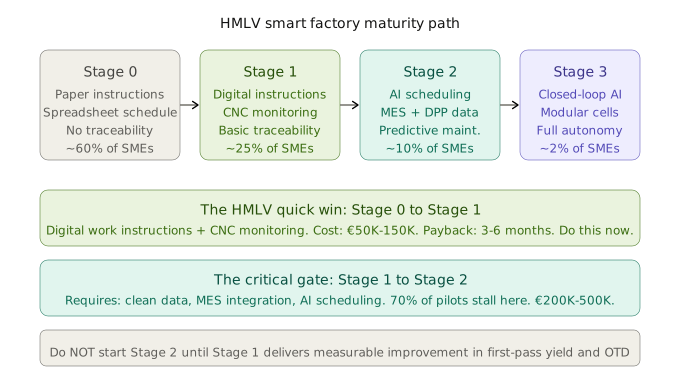
- Starting with predictive maintenance instead of work instructions. Your biggest loss isn’t machine downtime — it’s the 15 minutes per changeover, 200 times per month.
- Automating broken scheduling. Clean up master data first (routings, setup times, skill matrices), then digitise.
- Ignoring traceability until a customer demands it. Build serial-level tracking now — the cost of building it under pressure after a field failure is 5-10x higher.
- Over-scoping the first cobot deployment. Cobots excel at CNC machine tending. Complex multi-variant manual assembly in HMLV is the #1 cobot failure mode.
- Buying AI before you can see your own OEE (Overall Equipment Effectiveness). Every successful smart factory started with visibility, not algorithms.
What to Do Monday Morning
If you’re advanced (MES deployed, IIoT active, digital work instructions running)
- Map your MES traceability data against ESPR (Ecodesign for Sustainable Products Regulation) / DPP requirements for your product category
- Deploy AI scheduling across full production — connect ERP (Enterprise Resource Planning), MES, and machine data
- Implement variant-aware AI quality inspection at final assembly
- Begin Catena-X / Manufacturing-X onboarding if you supply OEMs
If you’re mid-maturity (some digital tools, no unified strategy)
- Deploy digital work instructions on your highest-error station — SaaS at €500-1,500/month
- Install protocol gateways on 5 CNC machines — €2K-10K each, 2-7 days per machine
- Implement cloud MES with traceability on one product line — €800-2,000/month
- Replace your spreadsheet schedule with a mid-market APS (Advanced Planning and Scheduling) tool — €18K-92K
- Apply for EU/national digitalisation funding — most countries offer 50% co-funding
If you haven’t started (paper, manual tracking, spreadsheets)
- Digital work instructions on one station — Tulip, ~€1,000/month, live in days
- Connect 3 CNC machines with IoT (Internet of Things) sensors — under €28K total
- Map your top 5 assembly error types with cost data
- Start serial-number tracking on your highest-value product — barcode scanning into a database within 3 months
- Budget €50K-150K for a 12-month Phase 1 — anything less produces a demo, not a production system
For mid-sized manufacturers building high-value, high-mix products with manual assembly, the smart factory priority is inverted from the standard playbook. Your bottleneck isn’t machine uptime — it’s how fast and accurately knowledge transfers between product configurations.
Digital work instructions, AI scheduling, and serial-level traceability deliver faster, more measurable ROI than predictive maintenance or computer vision for your production profile. The measurements that matter aren’t OEE and downtime — they’re first-pass yield, on-time delivery, and rework cost per variant.
Start where it hurts most. For your factory, that’s almost certainly the moment an operator picks up a new work order and asks: “How do I build this one?”
Stay Ahead of the Curve
Weekly analysis of the tech and related business trends that matter — hype-checked and grounded in reality.
Subscribe to The Signal →